
Research Projects
Below is a showcase of studies I've been fortunate enough to be involved in. Starting with my role as a undergraduate research assistant in a behavioral medicine lab, to my latest poster on A.I. in sonic branding, I've investigated, reported, and presented neuroscience and psychology findings globally.
Socioeconomic Status and Stress
Role: Co-Author and Poster Presenter
Since subjective and objective perecption of socioeconiomic status are related to health and behavior outcomes, we wanted to know which of the two is a stronger predictor to stress-evoked responses (heart rate).
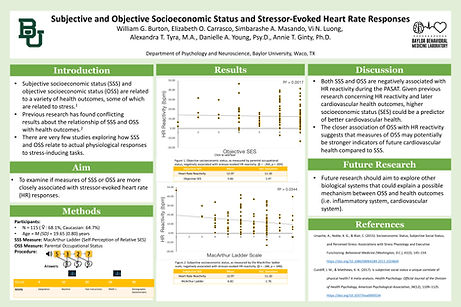
Student Assistant: my role included collecting, processing, and entering heart rate data.
Our hard work led us to Vancouver. We presented our poster at the annual meeting for the American Psychosomatic Society.
Gratitude and Stress Exposure
Role: Co-Author, Poster Presenter
This project aimed to explore the effects of experimentally induced gratitude on cardiovascular and psychological effects of acute stress during tasks (i.e. timed arithmetic).
For this project, I had more hands-on work with planning the project and analysis of HRV data following the collection.
Due to COVID-19, we weren't able to present at the APS conference in Los Angeles.

After I graduated from Baylor University, I began working in various business and psychology settings. These experiences alongside my previous marketing and advertising internships inspired me to further explore consumer behavior in London and Munich.
Master's Dissertation
AI vs. Humans: Emotion Tagging in Music
My master's thesis focused on the perception of music used in advertising. More specifically, we wanted to know if A.I. has the potential to emotionally perceive branded music the same as the average consumer or music expert. Using emotion rating scales and other data analysis techniques (i.e. PCA and Cosine Similarity Analysis), I explored the relationships between AI-generated, expert-generated, and consumer-generated emotional attributes of music used in advertising. After a sample of 300 participants, results showed no statistically significant similarity or alignment between the groups.
(kicker: differences in branded music may have influenced these results)
